The Day the Banks Said No
Maggie Lena Walker stood in the marble lobby of Richmond's First National Bank in 1903, holding a leather portfolio containing her business plan and life savings. She had just been turned away from the fourth bank that week.
 Photo: Maggie Lena Walker, via slidetodoc.com
"We don't do business with your kind," the loan officer had said, not even bothering to look at her carefully prepared documents.
Maggie was a successful businesswoman, the executive secretary of the Independent Order of St. Luke, a fraternal organization with thousands of members across Virginia. She had money to deposit, members who needed loans, and a vision for economic empowerment that could benefit the entire community.
But she was also a Black woman in Jim Crow Virginia, and that meant the banking system was closed to her—no matter how much money she brought to the table.
Walking home through Richmond's cobblestone streets, Maggie made a decision that would reshape American community finance: if the banks wouldn't serve her community, she would create one that would.
The Foundation of Exclusion
The systematic exclusion Maggie faced wasn't accidental—it was the point. Southern banks in the early 1900s operated on the principle that keeping Black Americans out of wealth-building institutions would maintain existing power structures.
Black families couldn't get mortgages to buy homes. Black entrepreneurs couldn't secure business loans to expand. Black workers couldn't even open basic savings accounts in most establishments. The message was clear: economic advancement was not for them.
But Maggie had learned something powerful during her years with the Independent Order of St. Luke: when people pool their resources and support each other, they can create their own opportunities.
"If we cannot get what we want in one way," she told her organization's annual convention, "we must get it in another."
Building Trust One Dollar at a Time
Maggie's first step was radical in its simplicity: she convinced the Independent Order of St. Luke to start a mutual savings program. Members would contribute small amounts each week, and the pooled money would be available for loans to other members.
It started small—domestic workers contributing fifty cents a week, shop owners adding a dollar, teachers pooling their modest salaries. But Maggie understood that trust, not capital, was the real foundation of banking.
She personally visited every member who took a loan, checking on their businesses, offering advice, sometimes helping with bookkeeping. When traditional banks saw customers as credit risks, Maggie saw them as community investments.
"We are not just lending money," she explained to her growing team of volunteers. "We are lending hope."
The Penny Savings Bank Revolution
By 1903, the mutual savings program had grown large enough that Maggie could take the next step: chartering an actual bank. The St. Luke Penny Savings Bank opened its doors on November 2, 1903, making Maggie the first Black woman in America to found and run a bank.
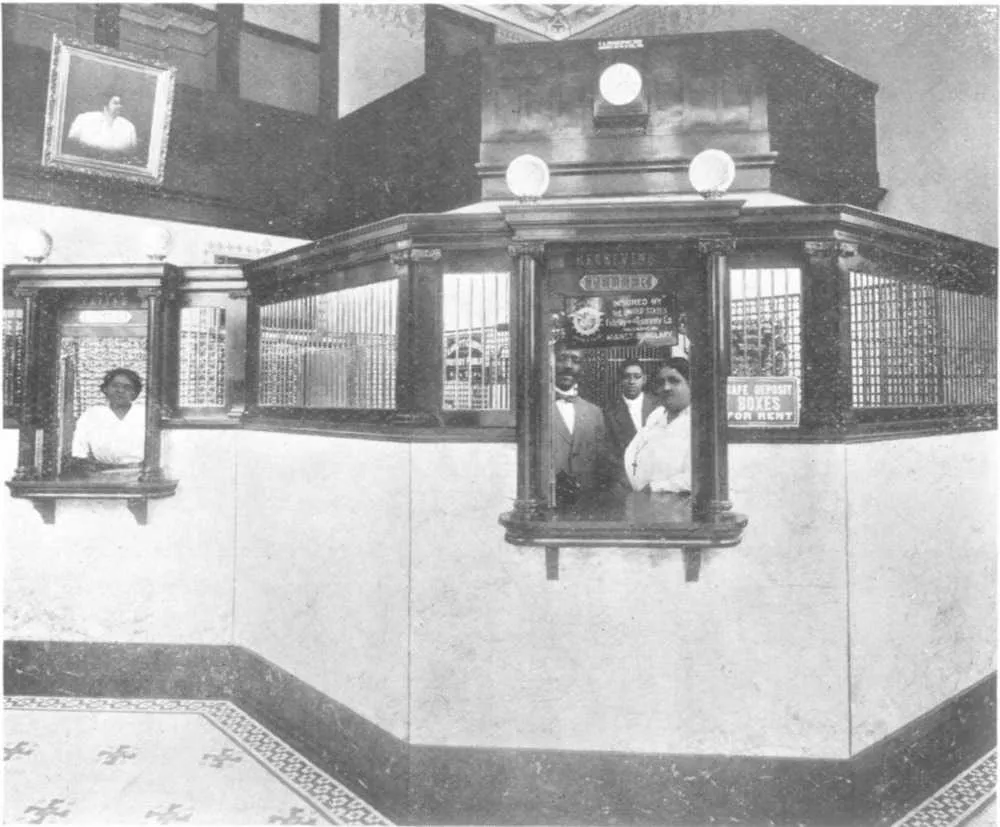 Photo: St. Luke Penny Savings Bank, via www.searchablemuseum.com
The name was deliberate. "Penny" suggested that anyone could participate, no matter how small their means. The bank's motto, painted in gold letters across the front window, read: "Bring Us Your Pennies and We'll Make Them Dollars."
Traditional bankers scoffed. How could an institution built on pennies and small deposits ever compete with established banks? They were missing the point entirely.
The Network Effect
Maggie wasn't trying to compete with white banks—she was creating something entirely different. The St. Luke Penny Savings Bank operated more like a community development corporation than a traditional financial institution.
When a member wanted to start a grocery store, the bank didn't just provide a loan—it helped find suppliers, connected them with experienced merchants, and promoted the business through the Independent Order's network.
When families needed mortgages, the bank worked with local contractors and real estate agents to ensure fair pricing and quality construction. They weren't just financing homes; they were building neighborhoods.
"A bank is only as strong as the community it serves," Maggie wrote in the St. Luke Herald, the organization's newspaper. "And a community is only as strong as the institutions that invest in its people."
Beyond Banking: Creating an Ecosystem
Maggie understood that financial exclusion was just one part of a larger system designed to limit Black economic opportunity. So she began building alternatives to every piece of that system.
The Independent Order launched the St. Luke Emporium, a department store that provided quality goods at fair prices while employing community members. They started an insurance company to protect families from financial catastrophe. They created a newspaper to share financial education and business opportunities.
By 1920, Maggie had built what economists would later recognize as one of America's first comprehensive community development financial institutions—a network of businesses and services designed to keep money circulating within the community.
The Opposition Strikes Back
Maggie's success didn't go unnoticed by the white business establishment. As the St. Luke enterprises grew, they began to threaten established merchants and financial institutions.
In 1905, Virginia passed new banking regulations clearly designed to limit the growth of Black-owned financial institutions. White-owned stores began pressuring suppliers not to sell to the St. Luke Emporium. Insurance companies refused to provide coverage for Black-owned businesses.
But Maggie had anticipated this resistance. She had built her network to be as self-sufficient as possible, with multiple revenue streams and deep community roots that couldn't be easily disrupted.
"They can make the rules," she told her board of directors during a particularly challenging period, "but they cannot make us quit."
The Great Depression Test
The true test of Maggie's vision came during the Great Depression. Banks across America were failing, taking their customers' life savings with them. Between 1929 and 1933, more than 9,000 banks closed their doors forever.
The St. Luke Penny Savings Bank not only survived—it thrived. While other institutions had invested in speculative markets and distant ventures, Maggie's bank had focused on local loans secured by real assets and personal relationships.
When unemployed members couldn't make loan payments, the bank worked out modified terms rather than foreclosing. When local businesses struggled, the bank provided emergency credit to keep them operating. The community-first approach that white bankers had mocked proved to be the most stable foundation of all.
A Legacy That Outlasted the Opposition
Maggie Walker died in 1934, but the institutions she built continued to serve Richmond's Black community for decades. The St. Luke Penny Savings Bank eventually merged with other Black-owned banks, becoming part of what is now the oldest continuously operating Black-owned bank in America.
The Independent Order of St. Luke still exists today, providing insurance and financial services to thousands of families. The principles Maggie established—community ownership, local investment, mutual support—became the foundation for credit unions, community development financial institutions, and other alternative banking models across the country.
The Model That Changed America
What Maggie created in Richmond became a template for excluded communities across America. When immigrant communities faced banking discrimination, they created ethnic banks and credit unions. When rural communities lost access to traditional financial services, they formed agricultural cooperatives and community loan funds.
The community development finance movement that emerged in the 1960s and 70s drew directly from the model Maggie had pioneered sixty years earlier: local ownership, community control, and investment in people rather than just profit.
"Mrs. Walker showed us that exclusion is only permanent if you accept it," wrote civil rights leader and economist Julianne Malveaux. "She proved that communities can build their own economic power when existing institutions fail them."
Lessons for Modern Outsiders
Today, as traditional banking continues to consolidate and exclude various communities—rural areas, immigrant populations, the formerly incarcerated—Maggie's model offers a roadmap for building alternatives.
Modern community development financial institutions, online lending cooperatives, and peer-to-peer finance platforms all echo principles she established over a century ago: start where you are, use what you have, serve who others won't.
The technology has changed, but the fundamental insight remains: when the existing system locks you out, the solution isn't to keep knocking on closed doors—it's to build your own doors.
The Power of Parallel Systems
Maggie Walker's story illustrates something profound about American opportunity: sometimes the greatest innovations come not from those welcomed into existing systems, but from those forced to create new ones.
Because she couldn't access traditional banking, Maggie had to think differently about what banking could be. Her exclusion forced innovation that benefited not just her immediate community, but generations of Americans who found themselves outside mainstream financial institutions.
"The banks that wouldn't serve us taught us to serve ourselves," she once wrote. "And in learning to serve ourselves, we learned to serve our community better than they ever could."
In a country built on the promise of economic opportunity, Maggie Walker proved that when that promise is broken, the solution isn't to accept the exclusion—it's to build something better from the ground up.